
Layered Spot Execution Strategies: A Smarter Way for Corporate Treasurers to Improve FX Execution

For many businesses, foreign exchange is simply viewed as an operational necessity. Payments need to be made, invoices need to be settled and currencies need to be converted.
However, how those transactions are executed can have a significant impact on the overall cost of doing business.
Many companies still execute FX transactions on an ad hoc basis, converting currency whenever a payment becomes due or when someone in the finance team requests a trade. While this approach is straightforward, it often means the business is relying on luck when it comes to exchange rates.
A more structured approach is the layered spot execution strategy. Rather than attempting to predict the perfect time to trade, a layered strategy uses market volatility to improve the average execution rate while reducing market timing risk.
Filled at a single rate. The outcome hinges on one moment.
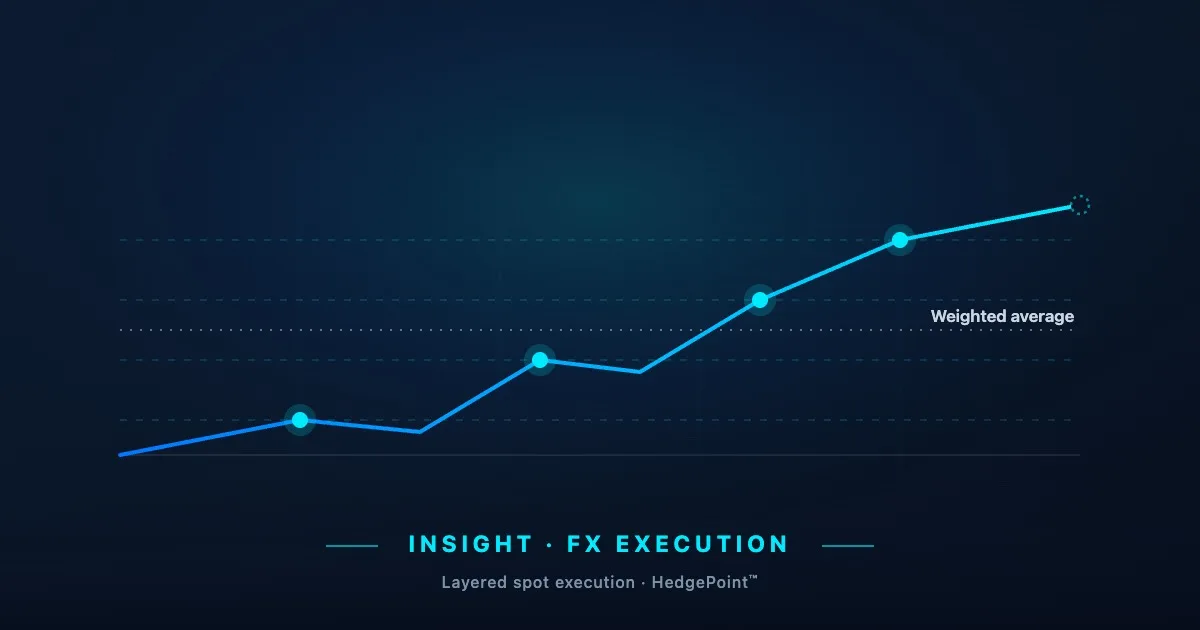
$1m × 10, filled at predefined levels, for a blended average.
What is a layered spot execution strategy?
A layered spot execution strategy involves dividing a larger FX requirement into multiple smaller trades, each executed according to predefined rules rather than at a single point in time.
For example, instead of purchasing US$10 million in one transaction, a company could divide the trade into ten equal tranches of US$1 million.
Each tranche is then placed at progressively more favourable exchange rate targets, for example every 0.10% improvement above the current market rate.
As the market moves, those target orders are automatically executed when the required exchange rate is reached. Any remaining balance can be completed before an agreed payment deadline, ensuring the business always meets its operational obligations.
The result is a blended average execution rate rather than reliance on a single market price.
Swipe to follow the trade window
Why does it work?
Foreign exchange markets are constantly moving. Even the world’s most liquid currency pairs experience meaningful day-to-day volatility.
Typical long-term realised volatility is approximately:
| Currency pair | Average daily volatility | Average weekly volatility |
|---|---|---|
| GBP/USD | 0.60–0.75% | 1.4–1.8% |
| GBP/EUR | 0.40–0.55% | 0.9–1.3% |
| GBP/AUD | 0.80–0.90% | 1.8–2.2% |
| GBP/ZAR | 1.0–1.4% | 2.8–4.5% |
| GBP/MXN | 0.9–1.3% | 2.5–4.0% |
These normal market movements create opportunities to improve execution without attempting to predict market direction.
Instead of asking whether to trade today or wait until tomorrow, a layered strategy asks a better question: how can we systematically participate in favourable market movements while still completing the transaction on time?
That shift in mindset is often where the value lies.
The objectives of a layered strategy
A layered execution strategy has several key objectives:
- Reduce market timing risk.
- Improve the average exchange rate achieved over time.
- Replace emotional decision-making with a consistent execution policy.
- Align FX execution with treasury governance and internal controls.
- Increase transparency and auditability.
- Improve budgeting by reducing execution volatility.
- Automate a process that is often highly manual.
Importantly, the objective is not to speculate on currency markets or to guarantee a better exchange rate. Instead, the strategy seeks to create a disciplined execution framework that allows businesses to benefit from normal market movements while reducing reliance on a single trading decision.
- Trade timed by gut feel
- One rate, one moment
- Emotion-led decisions
- Hard to benchmark or audit
- Inconsistent outcomes
- Rules-based target levels
- Spread across the period
- Blended average rate
- Fully documented and auditable
- Consistent and repeatable
The benefits for corporate treasurers
Reduced timing risk
Executing an entire FX requirement at one point in time exposes the business to the risk of trading at an unfavourable exchange rate. Layering spreads this risk across multiple executions.
Better average execution
Although outcomes can never be guaranteed, many businesses find that spreading execution across several market levels produces a more competitive weighted average exchange rate than repeatedly executing trades at arbitrary moments.
Improved treasury governance
Layered execution creates a documented and repeatable process. Every trade follows predefined rules, making treasury operations more transparent and easier to audit.
Automation
Modern treasury technology can automatically monitor markets, place target orders, execute trades and produce comprehensive reporting, reducing manual intervention.
Better reporting
Rather than simply recording the exchange rate achieved, treasury teams can measure performance against agreed benchmarks such as:
- Spot rate at strategy inception
- Daily average market rate
- Weekly average market rate
- Historic execution performance
- Internal treasury policy targets
What could it be worth?
Consider a company purchasing approximately US$500 million each year. Assuming an exchange rate of approximately GBP/USD 1.34, this represents around £373 million of annual currency purchases.
Even relatively small improvements in average execution can be financially meaningful.
| Average improvement | Approximate annual benefit |
|---|---|
| 0.20% | ≈ £750,000 |
| 0.40% | ≈ £1.49 million |
| 0.60% | ≈ £2.24 million |
| 0.80% | ≈ £2.99 million |
| 1.00% | ≈ £3.73 million |
These figures are illustrative and assume the stated annual trading volume. Actual results will depend on market conditions, execution parameters, liquidity and the timing of underlying commercial requirements.
Every business is different
There is no single execution strategy that suits every organisation. Some businesses may benefit from:
- Weekly layered execution.
- Daily execution schedules.
- Volatility-based target spacing.
- Hybrid strategies combining target orders with time-based execution.
- Layered spot execution combined with forward contracts or options.
The appropriate strategy depends on:
- Currency pair.
- Market volatility.
- Cash flow certainty.
- Treasury policy.
- Risk appetite.
- Payment deadlines.
A tailored approach is usually more effective than a one-size-fits-all model.
The importance of historical analysis
Perhaps the most powerful way to assess the potential value of a layered execution strategy is to analyse how it would have performed using a company’s own trading history.
Rather than relying solely on generic market statistics, a historical execution analysis compares:
- The exchange rates actually achieved.
- A simulated layered execution strategy using the same underlying commercial requirements.
- The difference in average execution.
- The estimated financial impact.
Using a client’s own historical data often provides a far more compelling basis for evaluating whether a structured execution strategy could improve treasury outcomes.
How HedgePoint helps
HedgePoint has been designed to help corporate treasury teams bring greater structure, automation and insight to FX execution. The Layered Spot Execution Strategy module enables businesses to:
- Design bespoke layered execution strategies.
- Automatically monitor market movements.
- Execute target orders according to predefined rules.
- Measure performance against multiple benchmarks.
- Calculate weighted average execution rates.
- Estimate realised savings.
- Generate detailed audit and management reports.
- Back-test strategies using historical transaction data.
The objective is simple: replace inconsistent, reactive FX execution with a disciplined, measurable and technology-driven process.
Complimentary historical execution analysis
At Jackson Swiss Partners, we offer a complimentary review of your previous 12 months of FX trading activity. Using your historical transactions, we can model how a layered spot execution strategy might have performed and provide an estimate of the potential impact on your average execution rate.
The analysis includes:
- Historical execution review.
- Simulated layered execution performance.
- Estimated weighted average rate improvement.
- Approximate financial impact.
- Suggested execution strategy based on your trading patterns.
- Recommendations tailored to your business and treasury objectives.
Every business trades differently. By analysing your own data, we can provide a practical, evidence-based assessment of whether a structured execution strategy could add value to your treasury function.
Final thoughts
Foreign exchange execution is often overlooked as a source of operational efficiency. Yet for businesses trading significant currency volumes, small improvements in execution can translate into meaningful financial benefits over time.
A layered spot execution strategy is not about predicting markets. It is about introducing discipline, reducing timing risk and making better use of the normal volatility that already exists in currency markets.
With the right technology, the process can be automated, measured and continuously refined, giving finance teams greater confidence in how their FX transactions are executed and reported.
Related
Explore related services from Jackson Swiss Partners, and the authoritative sources behind this analysis.
Key terms
Plain-English definitions for the concepts in this article, from our Financial Glossary.
Frequently asked questions
What is a layered spot execution strategy?
A layered spot execution strategy is an FX execution methodology that divides a large foreign exchange requirement into multiple smaller trades. Rather than executing one large transaction at a single exchange rate, trades are completed at predefined market levels over a specified period, helping reduce market timing risk and potentially improve the average execution rate.
What are the benefits of a layered FX execution strategy?
A layered execution strategy can reduce market timing risk, improve execution discipline, produce a blended average exchange rate, support treasury governance, automate FX execution, improve reporting and auditability, and reduce reliance on discretionary trading decisions.
Is a layered spot strategy suitable for all businesses?
Layered execution is generally most suitable for businesses that trade foreign currencies regularly and have flexibility over when FX transactions are executed. Companies with recurring imports, exports or overseas payrolls often benefit the most.
Which currency pairs are best suited to layered execution?
The strategy can be applied to most major and emerging market currency pairs, including GBP/USD, GBP/EUR, GBP/AUD, GBP/CAD, GBP/NZD, GBP/ZAR and GBP/MXN. The optimal spacing between execution layers depends on the historical volatility of each currency pair.
Does a layered execution strategy guarantee a better exchange rate?
No. Like any execution strategy, outcomes depend on market conditions. The objective is to improve consistency and reduce timing risk rather than to guarantee a specific financial outcome.
How can we determine whether a layered strategy would benefit our business?
The most effective approach is to analyse your own historical FX transactions. At Jackson Swiss Partners, we can review your previous 12 months of FX trading and simulate how a layered spot execution strategy may have performed using the same underlying commercial requirements.